England vs South Africa Semi-Final: Fantasy Differential Picks Under 20% Ownership
The England vs South Africa semi-final promises to be one of the most exciting contests of the tournament. While most fantasy cricket managers will rely on popular stars, experienced players know that winning a grand league often depends on selecting the right differential picks. These are players with less than 20% ownership who have the potential to deliver match-winning fantasy points while helping your team stand out from the crowd.
Differential picks are not just about choosing unpopular players. They are about identifying cricketers who have favorable matchups, recent form, or specific conditions that could allow them to outperform expectations. If you’re aiming for a top finish in fantasy contests, this England vs South Africa clash offers several underrated options worth considering.
Why Differential Picks Matter in Fantasy Cricket
In large fantasy contests, thousands of participants often select the same star players. While those picks provide stability, they rarely create enough separation to climb the leaderboard.
Low-ownership players can make a significant difference if they perform well. A wicket-taking spell, a quick fifty, or an all-round performance from a differential pick can give your fantasy team a major advantage over competitors who overlooked them.
Before finalizing your team, always review the latest playing XI, toss updates, and pitch report on the International Cricket Council (ICC) and ESPNcricinfo
Top Fantasy Differential Picks Under 20% Ownership
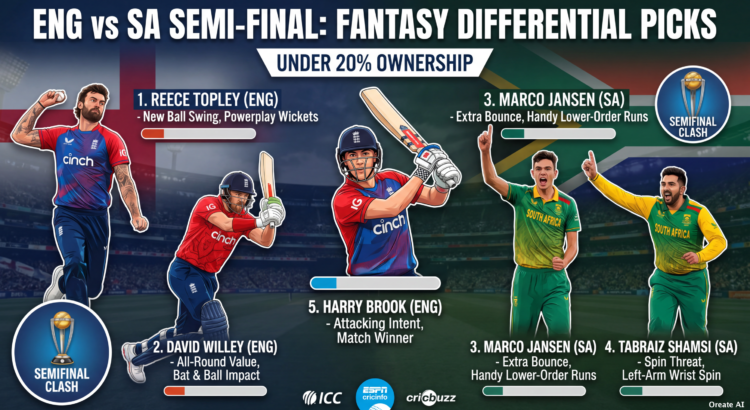
1. Reece Topley (England)
Reece Topley has the ability to swing the new ball and trouble South Africa’s top order. If conditions offer movement early in the innings, he can pick up wickets inside the powerplay. Since many fantasy users prefer England’s more popular bowlers, Topley could become an excellent differential selection.
Why pick him?
- Excellent new-ball bowler
- Strong wicket-taking potential
- Valuable powerplay overs
2. David Willey (England)
David Willey often goes under the radar despite contributing with both bat and ball. His ability to score useful lower-order runs while bowling crucial overs increases his fantasy value significantly.
Fantasy advantage
- Dual scoring opportunities
- Can swing the new ball
- Useful budget-friendly option
3. Marco Jansen (South Africa)
Marco Jansen has become one of South Africa’s most impactful all-rounders. His extra bounce creates wicket-taking opportunities, while his aggressive batting can add valuable fantasy points late in the innings.
Even if his ownership remains below 20%, his all-round ability makes him a genuine game-changer.
4. Tabraiz Shamsi (South Africa)
If the surface offers assistance to spin, Tabraiz Shamsi could become a surprise match winner. Left-arm wrist spin often creates problems for aggressive middle-order batters looking to accelerate.
Shamsi is especially valuable in fantasy contests where wickets carry higher scoring rewards.
5. Harry Brook (England)
Harry Brook has shown that he can change a game within a few overs. Although he may not always attract heavy ownership compared to England’s biggest names, his attacking intent makes him a valuable differential option.
If England lose an early wicket, Brook could receive enough time to build a big fantasy score.
Fantasy Strategy for Grand League Players
Selecting differentials does not mean filling your entire team with risky players. Instead, build your fantasy lineup around reliable performers and include two or three carefully chosen low-ownership players.
A balanced approach reduces overall risk while increasing your chances of climbing the rankings if one of your differential selections delivers an outstanding performance.
Captain and vice-captain choices should generally remain reliable unless you are entering high-risk grand league contests. In those formats, giving the vice-captain role to a quality differential all-rounder can produce significant rewards.
Pitch and Match Conditions
The pitch is expected to offer assistance to fast bowlers during the opening overs before becoming easier for batting. As the match progresses, slower bowlers and variations could become increasingly effective.
Fantasy managers should monitor the toss because chasing teams often benefit under lights depending on weather conditions. Final team selection should always be based on confirmed lineups rather than early predictions.
Reliable match updates can also be followed through Cricbuzz for last-minute fantasy decisions.
Players to Avoid Following Blindly
One of the biggest mistakes fantasy managers make is selecting highly owned players simply because everyone else is doing so. Popular players are certainly capable of scoring well, but they also carry the pressure of high expectations.
Instead of blindly copying public teams, evaluate:
- Current form
- Matchup against specific bowlers or batters
- Venue conditions
- Batting position
- Bowling quota
- Recent fantasy consistency
These factors usually provide a much stronger foundation for successful fantasy selections than ownership percentage alone.
Building a Winning Fantasy Combination
A smart fantasy lineup for this semi-final should include a healthy mix of premium stars and carefully selected differential picks.
Aim for:
- Reliable top-order batters
- At least one bowling differential
- One all-rounder capable of contributing in both departments
- Death-over specialists who can collect multiple wickets late in the innings
This balanced combination provides consistency while still giving your team the uniqueness required to compete in large fantasy contests.
FAQs
What is a fantasy differential pick?
A differential pick is a player selected by a relatively small percentage of fantasy users, typically below 20% ownership. These players can provide a competitive edge if they perform well.
Are differential picks suitable for small leagues?
Not always. Differential picks are generally more valuable in grand leagues where uniqueness is important. Small leagues often reward safer selections.
How many differential picks should I include?
Most fantasy experts recommend including two or three differential players while maintaining a strong core of consistent performers.
Should I make a differential player my captain?
Only if you’re targeting high-risk, high-reward contests. Otherwise, use proven performers as captain and consider a differential option for vice-captain if the matchup looks favorable.
When should I finalize my fantasy team?
Always wait for the official playing XI, toss result, and final pitch report before locking your fantasy team.
Final Thoughts
Winning fantasy contests is about finding the right balance between consistency and calculated risk. While star players will continue to dominate ownership, carefully selected differential picks under 20% ownership can become the deciding factor in grand league success. England vs South Africa is expected to be a tightly contested semi-final, making player selection even more critical.
Focus on current form, match conditions, and confirmed team news rather than simply following popular fantasy combinations. A couple of smart differential selections could be the difference between an average finish and a place at the top of the leaderboard.