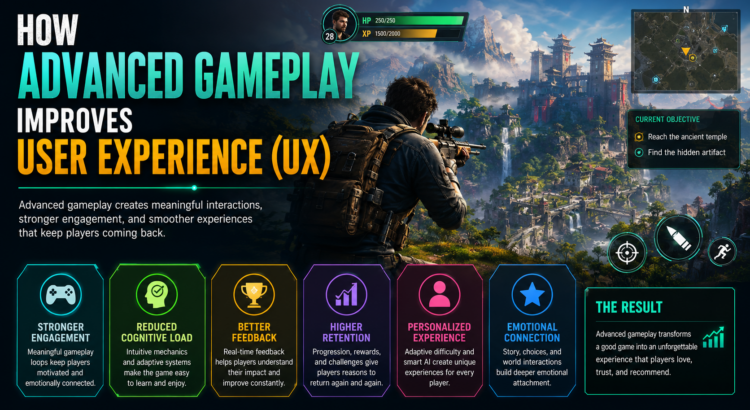
How Advanced Gameplay Improves User Experience
User experience (UX) in gaming is no longer just about visuals or smooth controls. Modern players expect deeper engagement, intelligent systems, and meaningful interaction loops. This is where advanced gameplay design plays a major role. It enhances how players feel, think, and respond while interacting with a game, ultimately shaping retention and satisfaction.
In this article, we will analyze key insights from industry sources and break down how advanced gameplay improves UX in a practical, structured way.
Analysis of Referenced Sources
To understand the topic clearly, let’s look at the core ideas from the provided references.
The first source discusses how UX in games focuses on emotional engagement, usability, and player satisfaction rather than just aesthetics or mechanics. It highlights that good UX design ensures players understand the game naturally without frustration or confusion.
Punchev Blog – Game UX Importance
The second source explains game UX from a research perspective, focusing on how player behavior, psychology, and interaction design shape engagement. It emphasizes that UX in games is deeply connected to motivation loops, feedback systems, and intuitive learning curves.
PlayerResearch – What is Games UX
The third source is a community discussion that highlights real-world developer challenges, such as keeping players engaged, balancing difficulty, and improving retention through better UX design choices like reward systems and onboarding improvements.
Reddit Game Design UX Discussion
Together, these sources show a common idea: great UX in gaming is driven by intelligent gameplay systems, not just visual polish.
What is Advanced Gameplay in UX Terms?
Advanced gameplay refers to mechanics and systems that go beyond basic interaction. It includes:
- Adaptive difficulty systems
- Dynamic storytelling
- Intelligent NPC behavior
- Reward and progression systems
- Real-time feedback loops
- Personalized player experiences
From a UX perspective, advanced gameplay ensures that players remain engaged without feeling lost, bored, or overwhelmed.
How Advanced Gameplay Improves User Experience
1. Creates Strong Player Engagement Loops
One of the biggest UX improvements comes from engagement loops. Advanced gameplay ensures that every action leads to meaningful feedback—whether it’s rewards, story progression, or skill improvement.
For example, progression systems that unlock abilities gradually keep players motivated. This reduces drop-off rates and increases session time.
When players feel that “something always happens after I act,” the UX becomes naturally satisfying.
2. Reduces Cognitive Overload
Good UX design removes unnecessary complexity. Advanced gameplay achieves this through:
- Gradual learning curves
- Contextual tutorials
- Adaptive UI hints
- Smart onboarding systems
Instead of overwhelming players with all mechanics at once, the game introduces features step-by-step. This creates a smoother and more enjoyable experience, especially for new users.
3. Enhances Emotional Connection
Modern UX in gaming is heavily emotional. Advanced gameplay uses storytelling, sound design, and dynamic events to build emotional engagement.
For example:
- A surprise mission trigger increases excitement
- Character development builds attachment
- Consequences of choices increase emotional weight
This emotional layer makes UX feel more “human” and less mechanical.
4. Improves Retention Through Progression Systems
Retention is a core UX metric in gaming. Advanced gameplay uses progression systems like:
- XP levels
- Skill trees
- Achievements
- Unlockable content
These systems give players long-term goals, which increases replay value. When users feel progress, they are more likely to return.
5. Personalizes Player Experience
Advanced gameplay often includes adaptive systems that respond to player behavior.
For example:
- AI adjusts difficulty based on performance
- Game suggests missions based on play style
- Dynamic events change based on past decisions
This personalization makes each player feel like the game is “built for them,” significantly improving UX satisfaction.
6. Strengthens Feedback Systems
Clear and immediate feedback is a core UX principle. Advanced gameplay ensures that every player action has visible or audible responses:
- Hit effects in combat
- Visual cues for success or failure
- Real-time score updates
- Environmental reactions
Without feedback, gameplay feels disconnected. With it, UX becomes immersive and responsive.
7. Encourages Exploration and Discovery
Modern players enjoy freedom. Advanced gameplay supports exploration through:
- Open-world design
- Hidden rewards
- Non-linear missions
- Interactive environments
This improves UX by giving players control over their journey instead of forcing linear progression.
Key Design Principles for Better Game UX
To effectively use advanced gameplay for UX improvement, developers should follow these principles:
- Keep mechanics intuitive but deep
- Prioritize player feedback at every stage
- Balance challenge and accessibility
- Use data-driven design for engagement tuning
- Avoid unnecessary complexity in UI/UX layers
- Focus on emotional and behavioral design, not just visuals
These principles ensure that advanced gameplay does not become overwhelming or confusing.
Real Impact of Advanced Gameplay on UX
When properly implemented, advanced gameplay leads to:
- Higher player retention
- Better user satisfaction scores
- Increased session duration
- Stronger community engagement
- More positive reviews and word-of-mouth growth
In short, it transforms a game from a simple product into a long-term experience ecosystem.
FAQs
1. What is the role of UX in gaming?
UX in gaming ensures that players can understand, interact with, and enjoy the game smoothly without confusion or frustration.
2. How does advanced gameplay improve engagement?
It improves engagement by creating meaningful feedback loops, rewards, and adaptive challenges that keep players interested.
3. Is advanced gameplay only for AAA games?
No. Even mobile and indie games can use advanced UX mechanics like progression systems and adaptive difficulty.
4. Why is player feedback important in UX?
Because it helps players understand their actions, progress, and impact in real time, making gameplay more immersive.
5. What is the biggest benefit of advanced gameplay UX?
The biggest benefit is increased player retention through deeper engagement and personalized experiences.
Final Thoughts
Advanced gameplay is no longer optional in modern game design—it is a core part of delivering high-quality user experience. As seen across industry research and developer discussions, the focus has shifted from simple mechanics to intelligent, adaptive, and emotionally engaging systems.
When gameplay is designed with UX in mind, players don’t just play a game—they experience it, connect with it, and return to it repeatedly.